A local-business machine, run almost entirely by AI.
Hank finds local businesses with failing websites, builds their new site before they ever ask, and signs them up — no sales team, no cold calls, almost no human hours. We test it together with a small month-one experiment; if the numbers show up, we scale it and sell it.
Drive twenty minutes past Lake St. Louis and count the businesses with no website, a dead Facebook page, or a site built in 2011 that takes eight seconds to load on a phone. These are good businesses — plumbers, dentists, HVAC crews, restaurants — losing customers every day to whoever shows up first on a phone screen.
And the ground just shifted under them a second time. People increasingly ask ChatGPT, Perplexity, and Google's AI for recommendations instead of clicking links. Those AI tools read structured, machine-readable websites. A business with a bad site was losing the Google game; a business with a bad site is completely invisible in the AI game. Almost nobody is selling them the fix — least of all at a price a small shop says yes to.
The wedge: Hank doesn't pitch them. He builds their new site first, mails a friendly postcard with a QR code to a private preview, and walks them through it and signs them up — as a clearly-disclosed AI. By the time they see it, the work is done. The only question left is "$39 a month to keep it?"
The brand is already real: Hank — the friendly neighbor who happens to be great with computers. "I made you some things." Warm, plain-spoken, zero jargon — built for a business owner who feels left behind by tech. hankbuilds.com is registered, the identity system is done (that's him up top), and every asset below is genuinely generated by the pipeline, not concept art.
Size of the prize
Small market per customer. Huge market of customers.
~33M
small businesses in the US
~1 in 4
still have no real website
60K+
small businesses in metro St. Louis alone
Figures are directional planning estimates, not audited market research — the pilot exists to replace assumptions with data.
We start in the St. Louis exurbs — where web presence is weakest and nobody's competing for these customers — and expand metro by metro using the exact same playbook. The pipeline doesn't care what city it's pointed at. Every metro is a fresh territory of thousands of qualifying businesses, and the qualifying criteria are objective and automated (Google's own speed scores, missing sites, no security certificate — not opinions).
This is not a "win a huge market" bet. It's a "nobody is serving these people at this price point, and Hank can serve them nearly for free" bet. Our cost to find, evaluate, build a site for, film a personalized pitch for, and mail a postcard to one business: about $1.50.
Behind the scenes
The factory line — already running
1
FindGoogle's business data surfaces every local business in a target area — name, phone, hours, website — for effectively $0 at our volume.
2
ScoreEach business gets an objective "bad website" score: no site, Facebook-only, slow on mobile, no security certificate, stale content. Only genuinely bad ones qualify — the pitch is honest by construction.
3
BuildAI generates them a clean, fast, mobile-first site from their own public info — including the structured data that makes them readable to ChatGPT & Google AI. Built before we ever talk to them. Five real ones are already live below.
4
FilmAn automated 40-second audit video of their actual site, narrated in a cloned voice, citing Google's own numbers. Personal at scale.
5
MailA Hank postcard (real proofs below — already designed and generated per-business) with a QR code and access code to their private, expiring preview. ~$0.90 each, dropping toward ~$0.55 at our 500+/month volume tier. API-triggered.
6
Close — no humansOn the preview site, Hank answers questions and signs them up: $39/month, $0 setup, checkout in the conversation. Clearly disclosed as AI, escalates edge cases to a real person.
7
The only human stepRare escalations and relationship moments. Deliberately the smallest box on the diagram — and it's the box you'd help own early on.
Then the real money: upsells into the accounts we've opened. A monthly AI-visibility report ($19–29), content refresh and review monitoring (bundled ~$79–99 tier), and the flagship — an AI phone receptionist that recovers the calls these businesses miss every day ($100–300+/month, a proven category). The $39 site is the foot in the door; the ladder is the business.
Real sites the pipeline already built
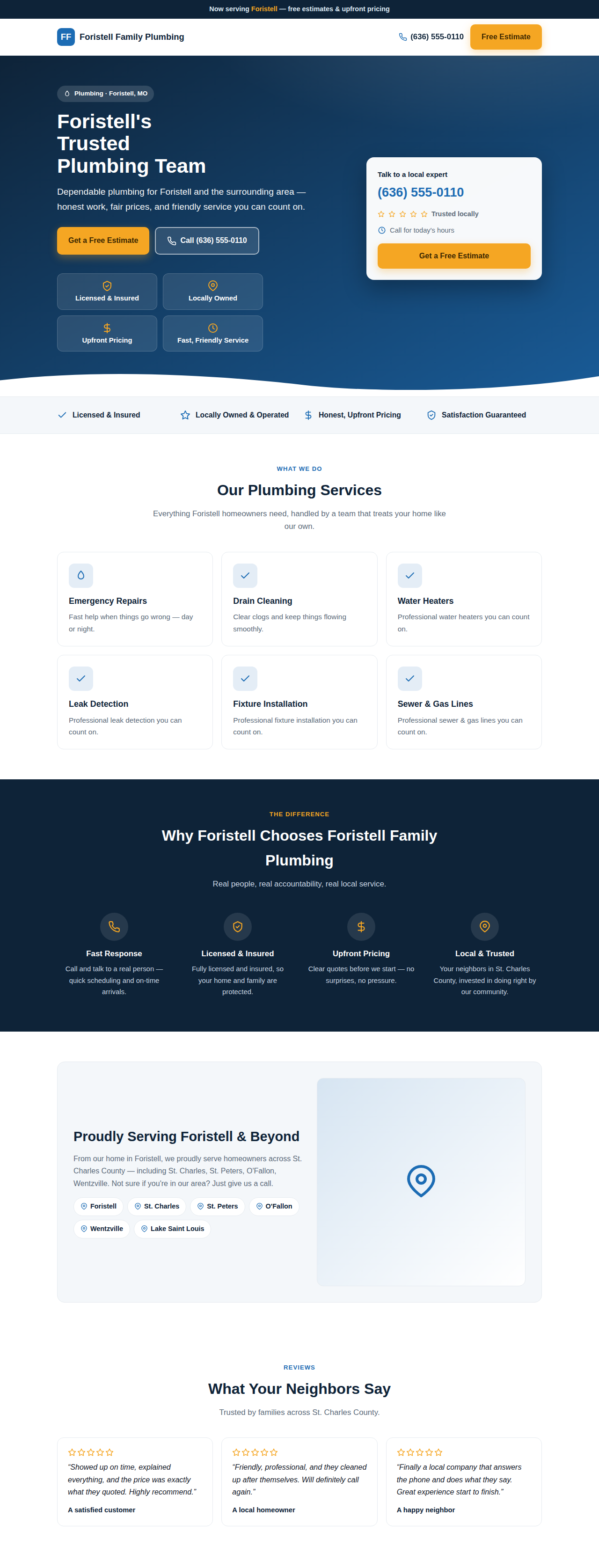
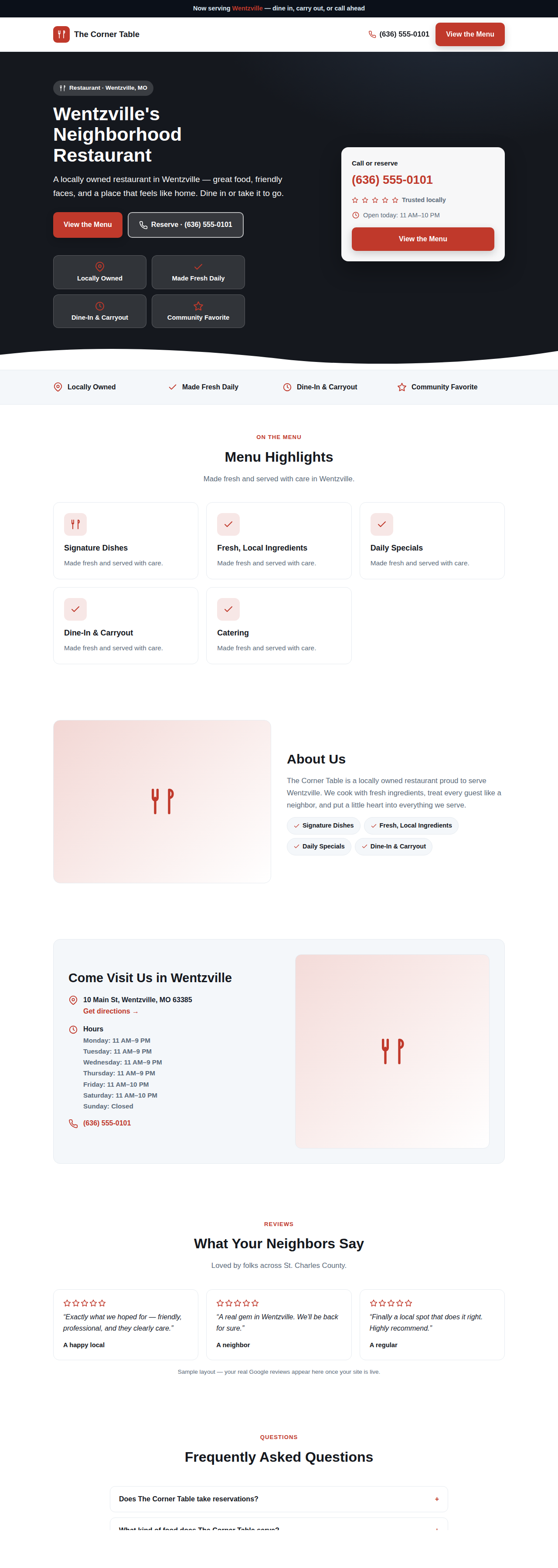
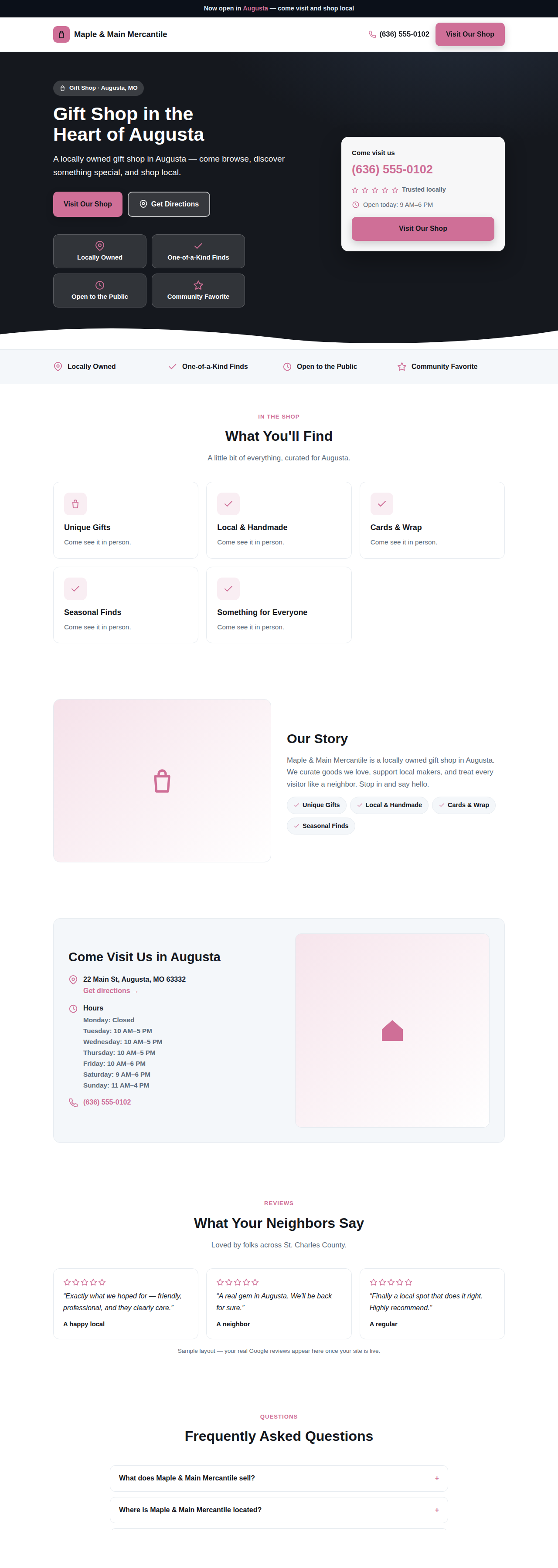
Not concept art — generated end-to-end by the machine for real qualifying businesses (Ellisville Heating & Air, Henderson Heating & Air, Lake St. Louis Heating and Cooling, Troy Heating & Cooling, George Littleton's Plumbing), plus category demos:
Trades template — generated preview siteRestaurant template — menu & hours forwardRetail template — different DNA per category
The design brain — sites that adapt, and get smarter every batch
The builder doesn't pour every business into one mold — you can see it in the gallery above. Design adapts to business type: a plumber's site leads with a giant tap-to-call and "24/7 emergency" above the fold, because their customer is standing in a flooded basement; a restaurant leads with menu, hours, and photos; a dental office gets a calm, clinical layout with booking front and center. Colors, tone, layout, and calls-to-action all key off the business's category — pulled from the same Google data that found them.
And it learns from the winners. The same grading engine that catches bad sites also studies the highest-scoring sites in each category — what the 90+ sites do with structure, speed, content, and CTA placement — and those patterns are folded back into the templates. Then our own portfolio becomes the second teacher: every preview site reports what visitors actually do (scroll, tap-to-call, buy), so each monthly batch ships templates that convert better than the last. That compounding feedback loop is a real asset at exit time — an acquirer isn't just buying customers, they're buying a design system trained on what makes local businesses convert.
🎁 The free brand kit — included with every subscription. Alongside the site, every customer gets a generated brand kit: cleaned-up, web-ready logo files, a matched color palette and font pairing, social banners, and a business-card-ready layout — it's even on the postcard ("plus a free brand kit to match"). Costs pennies to generate; feels like hundreds of dollars of agency work. It's the "you walk away with something real" sweetener that makes $39/month feel like stealing.
The gate code rotates every 24 hours — I'll send you today's. You'll experience exactly what a business owner experiences.
The cadence engine
Every 30 days, the machine turns over. Nobody touches it.
Two clocks run at once. The batch clock: every 30 days, a fresh batch of ~500 scored businesses enters the pipeline — sites built, videos filmed, first postcards mailed — triggered on a schedule, capped by hard spend limits. The per-business clock: from the moment their postcard drops, each business walks a behavior-driven mail sequence inside their 60-day preview window. Every scan, conversation, and checkout is an event the engine sees — so nobody gets a "reminder" for something they already did, and buyers exit the sequence the second they subscribe.
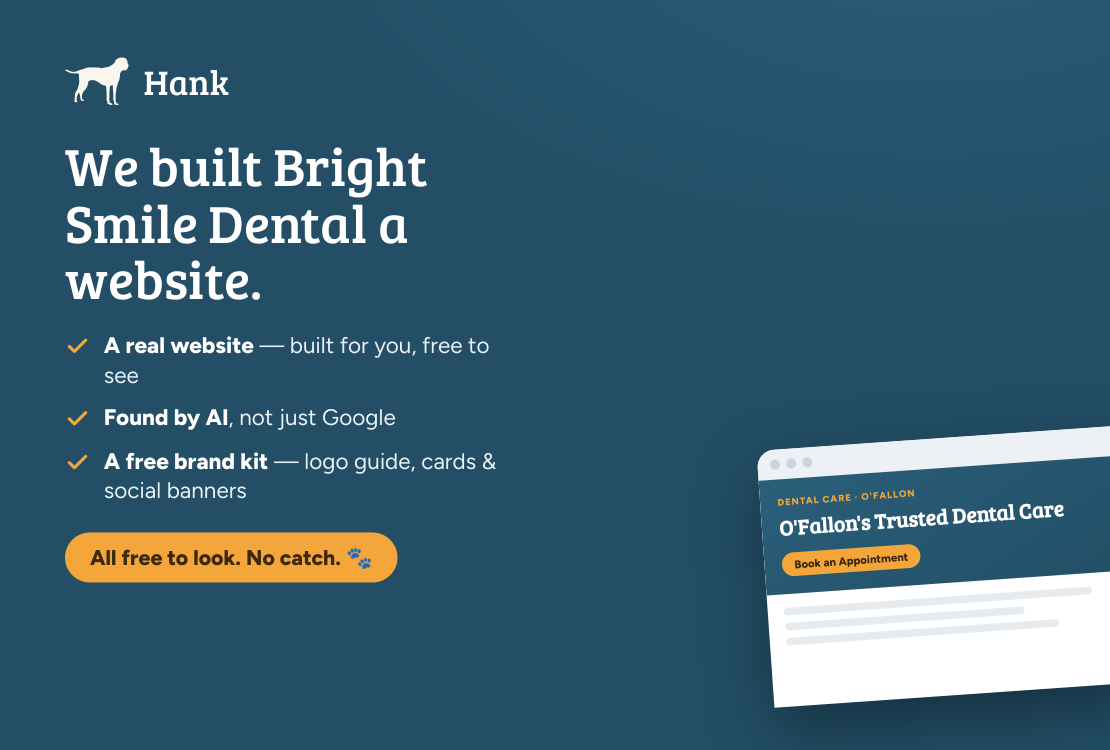
The real thing — Hank's postcard, generated per-business (front)
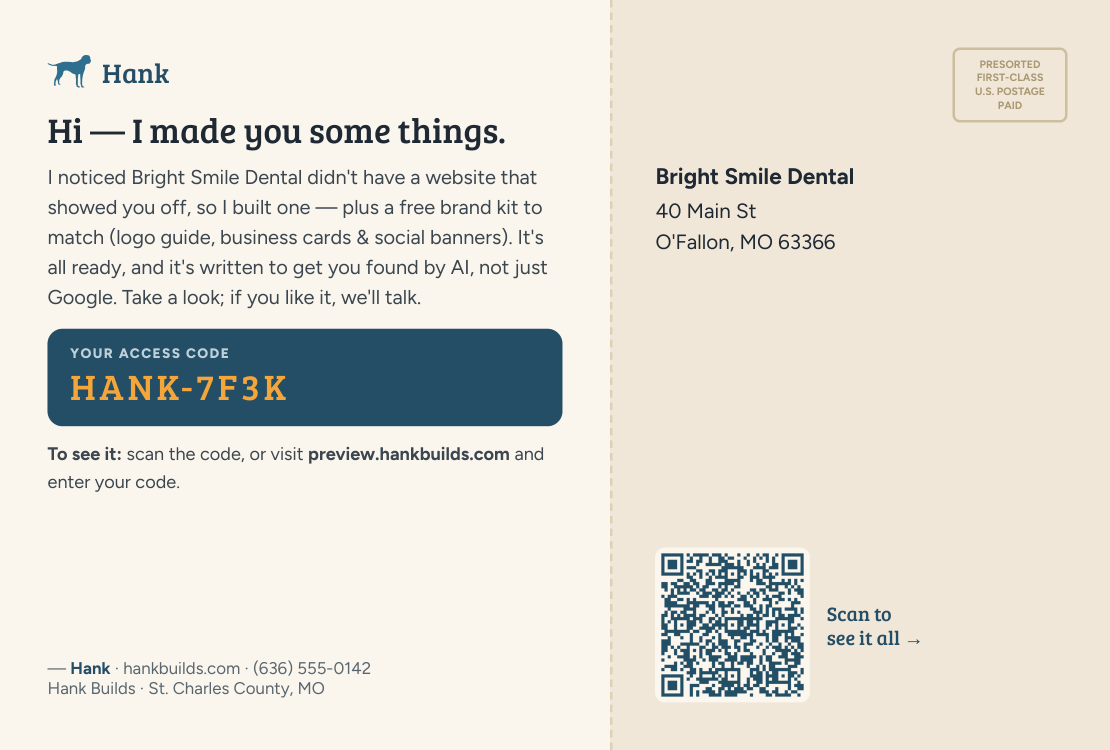
And the back — access code, QR, and Hank's note
Print-ready proofs from the actual postcard generator — each one is built per-business with their name, their preview URL, and their unique code.
D0
Mailer #1 — "I made you some things"The proof above: warm reveal, their name in the headline, free-to-look framing, access code + QR. The hook is that the work is already done.
D14
Mailer #2 — "Ask ChatGPT" (only if the code was never entered) Same system, different hook: "Ask ChatGPT for a dentist in O'Fallon — you're not in the answer. Your competitors are." Multi-touch mail consistently outperforms single-drop.
D45
Mailer #3 — the deadline(if not yet subscribed) "Your new website goes away in 15 days." Honest scarcity — the preview genuinely expires at day 60.
+
Ancillary mailers — after they're a customer"Your phone missed 11 calls last week — Hank's receptionist would've answered every one" (the $100–300/mo upsell), plus a printed AI-visibility snapshot as mailbox proof-of-value. Same engine, same cards, aimed at accounts we already own.
Under the hood it's a simple state machine per business — mailed → scanned → talked → subscribed / expired — with the gate, Hank, and checkout each reporting events, and the mail API triggered automatically when a business sits in a state past its timer. Every send checks the monthly spend cap first; the cadence can never outrun the budget. Cost honesty: worst case a business gets three cards, which moves estimated acquisition cost from ~$55 toward ~$75–85 if conversion didn't improve at all — but multi-touch sequences exist precisely because they lift response more than they lift cost. The pilot measures exactly that.
Unit economics
The math that makes it work
~$1.50
all-in cost to pitch one business
~$55
estimated cost to win one customer
~6 wks
to earn that back at $39/mo
Working assumptions (to be validated by the pilot, not taken on faith): about 3 in 100 mailed businesses become customers — 30% scan the postcard, half of those talk to Hank, a fifth of those buy. Even if we're half wrong, acquisition cost doubles to ~$110 and still pays back inside three months. The funnel is cheap enough to be wrong about and still win.
The real constraint isn't acquisition — it's human time. A $39/month customer can only absorb a few minutes of human attention per month before the margin's gone. That's why the entire design obsesses over automation: Hank closes, Hank onboards, Hank answers support questions. Humans are for exceptions. This constraint is also the moat — anyone copying this with a sales team loses money on every customer.
The road
Milestones: pilot → $1M profit → $10M exit
Stage
Customers
Revenue (ARR)
Gate to advance
Pilot (mo 1–3)
~15–45
~$7–21K
Real conversion & churn data from 500 businesses mailed in month one and each month after. Why 500, not 100: a 100-card test can't statistically tell a 1% funnel from a 6% one — 500 can. ~$1,100–1,300/mo to run.
Validation (mo 4–6)
~60–90
~$40K
Four-part trigger: conversion ≥2%, cost-per-customer ≤$110, churn ≤7%/mo, AI handles 90%+ of conversations. All four hold → expand immediately.
Multi-metro (yr 2)
~1,000
~$640K
The playbook replicates in 2–3 new metros at similar cost. Part-time VA runs the exception queue.
Profit target (yr 3–4)
~2,400
~$1.5M
$1M/yr net profit run rate. One real hire absorbing operations.
Businesses like this sell for roughly 3–5× profit. $1M/year of profit fetches $3–5M; the $10M exit needs roughly $2M+ in annual profit — about 5,000 customers — or premium metrics that justify a higher multiple. Here's our edge on the multiple: buyers pay premiums for businesses that don't need the founder. A company with documented, provable "AI runs everything, humans touch exceptions only" operations — plus a beloved consumer-facing brand like Hank — is the most transferable asset you can sell. Our lifestyle constraint (nearly hands-off) and our exit strategy (premium multiple) are the same strategy.
Bootstrap, sell, or take VC money?
Default path: bootstrap. 100% of profits reinvested until 5,000 customers. No investors, no dilution, we own the whole exit. The numbers above don't require outside capital — the machine funds itself after validation.
Where VC would make sense (and only here): if the pilot numbers come back meaningfully better than assumed — say conversion at 5%+ with low churn — then speed becomes the play: raising $1–2M to blitz 20 metros before anyone copies the playbook could turn a $10M exit into a $30–50M one. That's a good problem, we'd decide it together with real data, and it's the only scenario where giving up ownership beats keeping it. VC also makes sense if a strategic acquirer (a marketing agency roll-up, a local-services platform) shows early interest — capital accelerates toward a known buyer.
Where selling early makes sense: if we get to ~1,000 customers and an acquirer offers 4–5× ARR (~$2.5–3M) — that's a life-changing return on a $2K experiment and three years of light-touch work, and saying yes is allowed. We don't have to be heroes about the 10.
The partnership
I build Hank. Hank sells. You connect us to money.
Me — Rich
The factory
Build and run the entire pipeline (discovery, sites, videos, Hank, mailers, billing)
All technology, hosting, AI systems, spend guardrails
Already built: the brand, the postcard generator, five real preview sites, the demo, the cost model, the first pipeline stage
You
The capital & the connections
Test capital: $1–2K covers the entire month-one experiment — 500 businesses, mailed and measured
Connections to money & buyers: when the numbers justify it, intros to investors, strategic acquirers, and the people who write real checks. You are not selling websites to plumbers — ever. Hank does the selling
Occasional escalation point, early phases only: when Hank hands off a rare edge case (a handful a month by design), you're a friendly voice until the system matures — then even that goes away
When exit time comes: the relationships that put us in front of the right acquirer are worth more than any single year of profit
What $1–2K actually buys: the entire month-one experiment — 500 businesses found, scored, built, filmed, and mailed, follow-up cards included (~$1,100–1,300 all-in; postcards are the biggest line). That's a real sample: ~15 expected customers at modeled rates, enough to trust the numbers. After month one, early revenue plus my day-job income fund the machine — your capital buys the answer, not the runway. Every dollar is metered by hard spend caps; nothing can silently overspend.
Structure: deliberately decided later. The trial is just a trial — we don't paper an equity split over a $2K experiment. If the pilot numbers hit the triggers and we both want in, then we sit down and structure it properly in writing (equity vs. capital-plus-share, vesting, the works — with an hour of a real attorney's time, because friends who write things down stay friends). You get full visibility into every number the whole way: same dashboards I see.
Read this part twice
The honest part
You're a friend before you're a partner, so here's the whole truth:
This is not passive income on day one. "Near-zero human time" is the destination, not the starting point. The pilot months involve real (if light) attention from both of us.
The key numbers are still guesses. Conversion (3%) and churn (5%/mo) are modeled, not measured. The entire point of the pilot is to find out. They could come back worse.
Your $1–2K can go to zero. If the pilot says the model doesn't work, the honest move is to stop — and that money bought us the answer, nothing else.
The $39 tier alone never gets rich. The real profit lives in the upsell ladder (especially the AI receptionist). If upsells don't attach, this is a modest business, not a $10M one.
Timeline is years, not months. Exit-ready is realistically year 4–5. This is a slow-cooked asset, not a flip.
Your exit ramp: after the pilot reports (about 90 days), we look at the four trigger numbers together. If they're not there — or you're just not feeling it — you walk away clean, no hard feelings, friendship fully intact. That's the deal before any other deal.
Next steps
If you're curious, here's the whole ask
1
Play with the demoScan, enter the code, talk to Hank, "buy" the fake subscription. Ten minutes.
2
One conversationPoke holes in the math. Bring your skepticism — it's the most useful thing you can contribute this week.
3
If you're in: fund month one$1–2K, hard-capped, full visibility. I finish the build; 500 businesses get mailed.
4
Day ~90: numbers on the tableThe four triggers decide it. Green → we structure the real partnership and scale. Not green → we shake hands and grab a beer.